<?xml version="1.0" encoding="utf-8"?><feed xmlns="http://www.w3.org/2005/Atom" ><generator uri="https://jekyllrb.com/" version="3.10.0">Jekyll</generator><link href="https://ruikelyu.github.io/feed.xml" rel="self" type="application/atom+xml" /><link href="https://ruikelyu.github.io/" rel="alternate" type="text/html" /><updated>2026-10-19T20:44:45+00:00</updated><id>https://ruikelyu.github.io/feed.xml</id><title type="html">Ruike Lyu | Energy Systems Researcher</title><subtitle>Energy systems research combining power systems and macro-energy systems modeling to study industrial demand flexibility and energy infrastructure</subtitle><author><name>Ruike Lyu</name><email>rl3763@columbia.edu</email></author><entry><title type="html">在清华大学电机系2026年毕业典礼上的发言</title><link href="https://ruikelyu.github.io/posts/2026/06/blog-post-5/" rel="alternate" type="text/html" title="在清华大学电机系2026年毕业典礼上的发言" /><published>2026-06-28T00:00:00+00:00</published><updated>2026-06-28T00:00:00+00:00</updated><id>https://ruikelyu.github.io/posts/2026/06/blog-post-5</id><content type="html" xml:base="https://ruikelyu.github.io/posts/2026/06/blog-post-5/"><![CDATA[<p><img src="/images/post5.jpg" alt="Speech at the 2026 THU EE Graduation Ceremony" /></p>

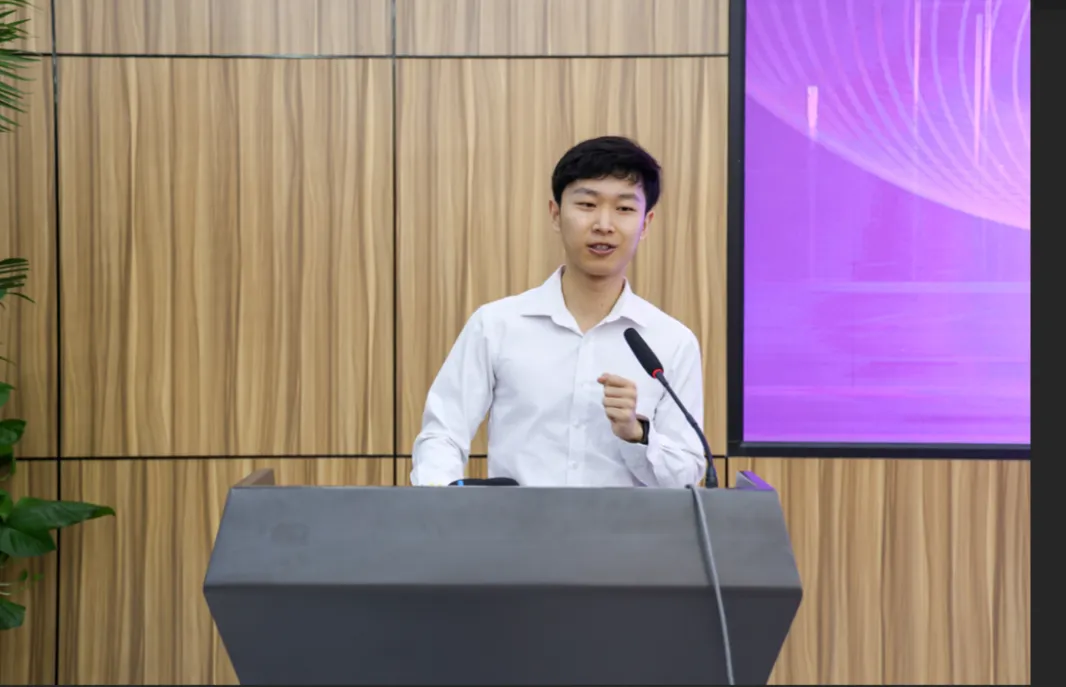
<p><em>The following is my speech as a graduate representative at the 2026 graduation ceremony of the Department of Electrical Engineering, Tsinghua University.</em></p>

<h2 id="发言全文">发言全文</h2>

<p>尊敬的各位来宾，各位老师、同学，各位亲友、爸爸妈妈们！</p>

<p>大家下午好！我是电机系2021级博士吕睿可，很荣幸作为毕业生代表发言。听说我要发言，我的爸爸、妈妈、舅舅、外公、表弟昨天请一天假也要从成都飞过来。所以我真的是很荣幸。</p>

<p>在这里，我先替同学们喊出那句话：爸爸妈妈，你们辛苦了！同时，我谨代表毕业生，向我们的各位恩师，表达诚挚的感谢和崇高的敬意！当然，最值得祝贺的，是今天的主角，2026届毕业生，大家毕业快乐！</p>

<p>我上一次参加毕业典礼是本科毕业的时候，因为我保研读博，虽然毕业了，但是也还在清华，还在电机系，还在课题组，还有导师照顾着我，所以我在学校里面还可以任性、犯错，不用直接面对社会的压力。清华园很大，撞不到南墙。但是这一次不一样，这一次是来真的了，真的要步入社会了。</p>

<p>我们真的要离开校园，跟新的人、在新的规则下、面对新的问题和挑战。要如何应对？我心里也没有很好的答案。但是我想，既然我拿到了清华大学博士文凭，说明母校觉得我到了可以走上社会的时候了。所以我在这里分享一下我的计划。</p>

<p>从今天起，我们不再是清华的学生，我们是国家电网的调度员、基层的公务员、大学的教授。别人不会再因为“清华”两个字而轻易认可我们，相反，人们会以更高的标准来看我们。我们对我们的评价，取决于我们在调度台前、在村镇里、在讲台上一天天的表现。我们需要一切从头开始。</p>

<p>从头开始的第一步，就是要做好一个普通人。我花一年时间写一篇论文，全世界真正看懂的可能也就10个人。但是全国几百万、几千万的人会去认可和接受一个网红的观点，因为他知道最大多数的人每天面对的是什么、考虑的是什么。上个月我论文送审后，我通过网络媒体，花了很多时间去看不同经历的人是在做怎样的思考和怎样的人生选择。我们离开清华后，必定要跟各种背景的人打交道，只有理解周围人的所思所想、诉求、逻辑，才能更好地发挥我们的能力和特长，一起解决问题、共同完成目标。</p>

<p>但是，做好普通人之后，我还要努力追求理想。毕业后，我们可能会发现，周围人好像很现实，吃饭的时候不再讨论在哪里建输电线，而是讨论在哪里买学区房。我们当然要理解现实、适应现实，但是也不能只被现实推着走。读博这件事，本身就是一种和“不现实”长期相处的训练。当很多同龄人已经走上工作岗位、建立家庭、承担起现实责任的时候，我们还在花几年时间研究一个可能没有答案的问题，写一篇可能一直被拒稿的论文。但我们仍然坚持，因为我们相信，有些问题值得被回答，有些方向值得去探索。如果每一个人都只选择最稳妥、最轻松、最现实的道路，那我想，这个世界上多很多生活稳定的人。但是，这个世界上也就不会有牛顿、爱因斯坦，不会有我们的优秀校友邓稼先、钱学森、杨振宁。当然，也不会有这么多人本科毕业后选择读博。</p>

<p>再次感谢我们的父母和家人，感谢你们给予我们坚实的支持；感谢老师们，你们带领我们走到今天，让我们有自信、有勇气能够去走入社会、去适应新的规则，但同时又敢于在周围的人都低头捡六便士的时候，还能抬头看见月亮，并朝着理想一直走下去。谢谢你们，你们辛苦了！</p>]]></content><author><name>Ruike Lyu</name><email>rl3763@columbia.edu</email></author><category term="Graduation" /><category term="Tsinghua University" /><category term="Personal Growth" /><category term="Speech" /><summary type="html"><![CDATA[]]></summary></entry><entry><title type="html">How to Approximate High-Dimensional Non-Convex Feasible Regions with Low-Dimensional Linear Constraints</title><link href="https://ruikelyu.github.io/posts/2025/03/blog-post-4/" rel="alternate" type="text/html" title="How to Approximate High-Dimensional Non-Convex Feasible Regions with Low-Dimensional Linear Constraints" /><published>2025-03-12T00:00:00+00:00</published><updated>2025-03-12T00:00:00+00:00</updated><id>https://ruikelyu.github.io/posts/2025/03/blog-post-4</id><content type="html" xml:base="https://ruikelyu.github.io/posts/2025/03/blog-post-4/"><![CDATA[<p><img src="/images/post4-1.jpg" alt="Data-Driven Dimension Reduction Framework" /></p>

<h2 id="research-background">Research Background</h2>

<p>When solving optimization problems, a fundamental principle is that simpler constraint forms (convex or linear) and lower dimensions typically result in faster solution times for the same objective function. Even in today’s era of advanced computing power, simplifications of generator or power grid models are still necessary to complete economic dispatch or market clearing within required timeframes. This represents a trade-off between model accuracy and computational feasibility.</p>

<p>In the future, with massive demand-side resources participating in source-load interactions, economic dispatch may need to incorporate demand-side resources several orders of magnitude greater than existing generator units. These resources (such as industrial production lines) may have more integer variables and nonlinear relationships, making constraint simplification even more critical. Depending on the scenario, this simplification may take the form of “aggregation,” “dimension reduction,” “relaxation,” “linearization,” etc., but essentially all address the same question: How can we replace complex constraints with more computationally tractable ones while keeping errors within acceptable limits? For convenience, we’ll use “dimension reduction” to refer to this problem.</p>

<p><img src="/images/post4-2.jpg" alt="Minkowski sum (the sum of two sets)" /></p>

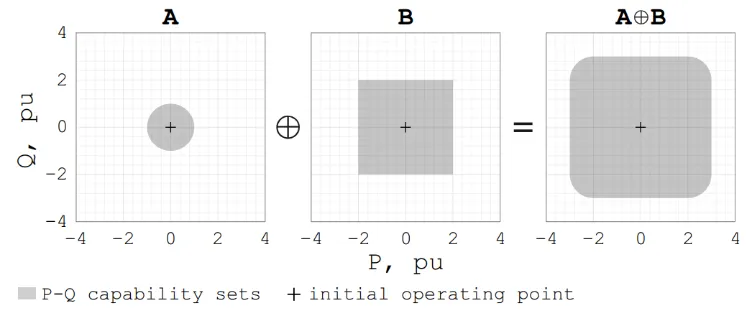
<p>Ideally, dimension reduction would use a lower-dimensional constraint to completely capture the original constraint. Mathematically, this is a projection problem or Minkowski sum (the sum of two sets). However, this approach has a fatal flaw: computing exact dimension reduction constraints is extremely complex (NP-hard). Figure 1 provides a visual explanation: Sets A and B can be easily represented—set A with a center and radius, set B with a few linear constraints. But analytically representing the sum of sets A and B is challenging. This is a simple case; for complex constraints, no computationally feasible algorithms exist.</p>

<p>Since exact dimension reduction is computationally intractable, existing methods primarily use computationally feasible approaches to approximate original constraints, such as inner approximation and outer approximation, both maintaining a simple rectangular constraint shape with parameters that can be relatively easily calculated from the original parameters of A and B. We call these analytical methods, characterized by using the mathematical form and parameters of the original constraints to derive dimension reduction constraints based on certain derivations and assumptions.</p>

<p>However, analytical constraint dimension reduction methods have significant limitations:</p>

<ol>
  <li>
    <p><strong>Limited adaptability</strong>: Analytical methods depend on the mathematical forms of the original and reduced constraints. If the original constraint form changes, the method may need manual modification.</p>
  </li>
  <li>
    <p><strong>Uncontrollable errors</strong>: Taking inner approximation as an example, it requires the feasible region of the reduced dimension constraint to be inside the original constraint’s feasible region. If set A’s radius is large in our example, the error from rectangular approximation would be substantial.</p>
  </li>
  <li>
    <p><strong>Most importantly</strong>, existing approximation methods (especially aggregation methods) require the original constraints to be convex, are incompatible with integer variables, and cannot accommodate demand-side resources like industrial production lines with numerous integer variables.</p>
  </li>
</ol>

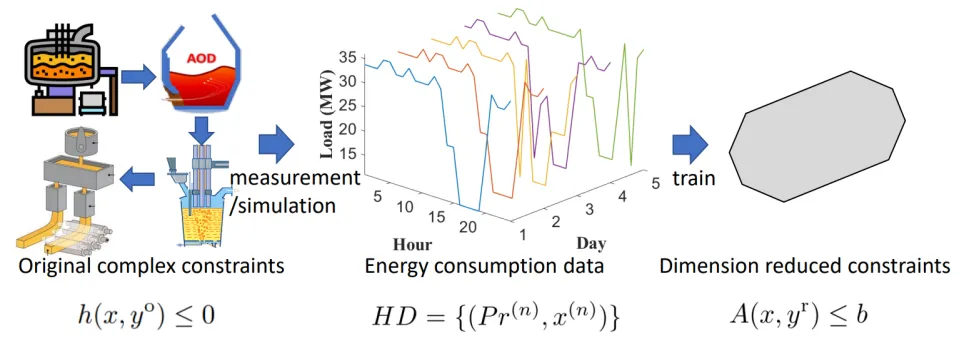
<p>In this paper, we explore a completely different approach from analytical methods, proposing a data-driven constraint dimension reduction method. The main idea is not to directly obtain the form and parameters of the original constraints, but to obtain optimal solutions to optimization problems based on the original constraints (historical optimal solutions or simulated optimal solutions), treat them as optimal solutions to optimization problems based on dimension-reduced constraints, and use inverse optimization techniques to reverse-engineer the constraints. Our method does not depend on the form of the original constraints, thus having stronger adaptability and compatibility with constraints containing integer variables. The code is open-sourced (see link at the end). Below, we introduce the main methods and results using industrial load modeling as an example.</p>

<h2 id="problem-description">Problem Description</h2>

<p>Without loss of generality, our goal is to use a set of low-dimensional linear constraints Ax≤b to approximate the original high-dimensional complex constraints h(x, y)≤0 (original energy consumption constraints of industrial processes). If we require strict equivalence between the reduced and original constraints, this becomes a projection of the variable space corresponding to the original constraints onto the reduced constraints. However, strict projection may be computationally infeasible when the original constraints have high dimensions, integer variables, and time coupling. Moreover, in current source-load interactions, small deviations in demand-side response are acceptable. Considering these practical factors, we relax the conditions of strict projection and instead introduce a loss function to describe the error of the reduced constraints relative to the original ones.</p>

<p>Thus, our goal becomes determining appropriate parameter matrix A and vector b to minimize the approximation error. Specifically, rather than analytically deriving A and b based on the form and parameters of the original constraints h(·), we observe the historical energy usage of industrial users and fit A and b in a data-driven manner. In doing so, we assume we have historical energy usage data of industrial users who optimized their energy costs based on original constraints in the face of historical boundary conditions (fluctuating external electricity prices). This may be real historical data or simulated data. In either case, we do not directly use h(·), meaning the calculation process can be performed by entities other than the industrial user without needing to obtain their internal parameters, providing the additional benefit of privacy protection.</p>

<p>Under these assumptions, the approximation error can be represented as the distance between the optimal energy usage given by the original constraints and the reduced constraints under historical electricity prices. This serves as the objective function for fitting the reduced constraints, with the KKT conditions of the optimization problem constrained by A(x,y)≤b as constraints. Below, we introduce the specific problem formulation and solution method.</p>

<h2 id="solution-method">Solution Method</h2>

<p>Using data-driven inverse optimization to solve for optimal dimension reduction constraint parameters.</p>

<p>In principle, we could search for appropriate matrix sizes and element values in the entire space of A/b through inverse optimization. However, the high-dimensional search space and high-dimensional nonlinear constraints in the inverse optimization problem’s optimality conditions (due to potentially using multi-day data) might make computational costs unacceptable. Our solution approach is twofold: First, select an appropriate form of parameter matrix based on industrial user energy usage characteristics (adjustable load clusters); then, design a solution algorithm based on zeroth-order stochastic gradient descent to iteratively solve the inverse optimization, and reduce the computational complexity of each iteration through optimality condition transformation (Fortuny-Amat transformation).</p>

<p>We chose an adjustable load cluster as the form of low-dimensional linear constraints to fit, mainly for two reasons: First, in common general models such as the State-Task Network (STN) and Resource-Task Network (RTN) developed from it, common industrial process characteristics like production goal constraints and equipment composition relationships can be well captured by a cluster of multiple adjustable loads; second, the adjustable load cluster model is a commonly used load model in power systems, with low computational complexity and compatibility with existing models such as economic dispatch.</p>

<h2 id="numerical-test-results">Numerical Test Results</h2>

<p>We tested the proposed Data-Driven Dimension Reduction (D3R) method on three datasets: a cement plant, a steel powder manufacturing plant, and an ironmaking plant. The first two were modeled with STN models, while the ironmaking plant was modeled with an RTN model—all typical models with high-dimensional constraints and integer variables. For these complex models, there are no mature dimension reduction or projection methods that consider multi-period coupling, so we compared D3R with a simple adjustable load model (SAL) and an optimal virtual battery model (OVB) based on inner approximation.</p>

<p>Results show that D3R achieved the best performance across all three datasets, meaning the reduced constraints obtained by this method gave optimal energy usage results with the lowest NRMSE compared to results based on original constraints in the test set. The OVB method based on analytical inner approximation performed much worse and is not applicable to dimension reduction of constraints with integer variables.</p>

<h2 id="conclusion">Conclusion</h2>

<p>Unlike traditional analytical constraint dimension reduction approaches based on constraint forms and parameters, we propose directly using optimal solutions to optimization problems based on original complex constraints to train low-dimensional linear constraints that best fit the original constraints. In the scenario of industrial load modeling, we preliminarily validated this idea’s feasibility using an adjustable load model with parameters fitted based on inverse optimization. The proposed method outperformed other comparison methods on three industrial load datasets. Our research provides a novel approach to solving complex constraint dimension reduction and approximation involving integer variables.</p>

<h2 id="resources">Resources</h2>

<ul>
  <li>Explanation Video: <a href="https://www.bilibili.com/video/BV1JFQ1YwEsK">Video Link</a></li>
  <li>Data and Code: <a href="https://github.com/ruikelyu/Data-Driven-Dimension-Reduction">https://github.com/ruikelyu/Data-Driven-Dimension-Reduction</a></li>
  <li>Original Paper: <a href="https://ieeexplore.ieee.org/document/10902053">https://ieeexplore.ieee.org/document/10902053</a></li>
  <li>Original Chinese Article: <a href="https://mp.weixin.qq.com/s/L-_tr6lyHOflz5IsfBJK2A">THU EE Graduate Student WeChat</a></li>
</ul>

<p><strong>Citation Format:</strong>
R. Lyu, H. Guo, G. Strbac and C. Kang, “Data-Driven Dimension Reduction for Industrial Load Modeling Using Inverse Optimization,” in IEEE Transactions on Smart Grid, doi: 10.1109/TSG.2025.3545339.</p>]]></content><author><name>Ruike Lyu</name><email>rl3763@columbia.edu</email></author><category term="Optimization" /><category term="Dimension Reduction" /><category term="Industrial Load Modeling" /><category term="Inverse Optimization" /><category term="Data-Driven Methods" /><summary type="html"><![CDATA[]]></summary></entry><entry><title type="html">Digital Twin Modeling of Industrial Loads Using Smart Meter Data</title><link href="https://ruikelyu.github.io/posts/2025/01/blog-post-3/" rel="alternate" type="text/html" title="Digital Twin Modeling of Industrial Loads Using Smart Meter Data" /><published>2025-01-19T00:00:00+00:00</published><updated>2025-01-19T00:00:00+00:00</updated><id>https://ruikelyu.github.io/posts/2025/01/blog-post-3</id><content type="html" xml:base="https://ruikelyu.github.io/posts/2025/01/blog-post-3/"><![CDATA[<p><img src="/images/smart_meter.jpg" alt="Research on industrial load modeling" /></p>

<h2 id="research-background">Research Background</h2>

<p>This research originated from an industry need: before implementing large-scale demand response programs, grid operators want to know which users can adjust their power consumption and by how much. This requires building a database of control capabilities, but manual inspections lack objectivity and real-time accuracy. Is there an automated assessment method?</p>

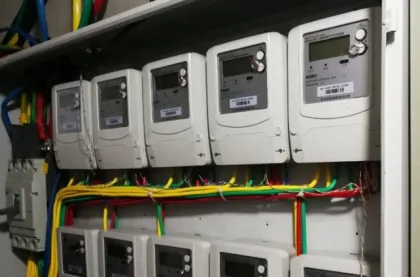
<p>You might have seen smart meters near your home’s entrance or apartment building. These meters record each user’s total electricity consumption, typically hourly (or every 15 minutes), and can transmit data to the utility company in real time. Is it possible to use smart meter data to reverse-engineer information about what’s happening inside a facility?</p>

<p>Smart meter data has already found numerous applications. For example, analyzing electricity usage patterns can reveal household composition: if electricity usage significantly decreases after 10 PM every night, the home likely has no young people. However, most analyses only apply simple machine learning algorithms like classification or clustering, and their capabilities remain limited—they cannot accurately obtain information about the user’s internal electrical equipment.</p>

<p>Non-intrusive load monitoring (NILM) technology can be used to obtain information about internal electrical equipment using total meter data. NILM decomposes the user’s total meter data into data for each electrical device, which can be used to preliminarily assess the user’s response capability. However, NILM typically requires high-frequency data collection, at least once per minute—far exceeding the hourly smart meter data collection and storage frequency.</p>

<p>In summary, although smart meter data may be the grid’s most convenient channel for obtaining information about power users’ energy usage, existing research has not yet achieved accurate modeling of users using smart meter data—this is the issue we want to explore in this paper. In particular, we focus on energy-intensive industrial users, such as cement and metallurgical industries, because they have greater regulation potential, mature control methods, and are more sensitive to incentive measures.</p>

<p>Specifically, our goal is to build digital twin models of industrial users’ energy usage solely using smart meter data. Here, the concept of “digital twin” has three levels:</p>

<ol>
  <li>
    <p><strong>Physical Layer</strong>: The data foundation of the digital twin. Hourly energy curves of the entire factory are collected through smart meters and uploaded in real time.</p>
  </li>
  <li>
    <p><strong>Digital Layer</strong>: The core of the digital twin. First, a mathematical model of industrial user energy usage is established based on energy mechanisms; then, model parameters are inversely deduced based on smart meter data collected in the physical layer. The parameterized model reflects the state, behavior, and performance of factory equipment in the real world.</p>
  </li>
  <li>
    <p><strong>Cognitive Layer</strong>: The intelligent part of the digital twin. The model and data from the digital layer are used for analysis, decision-making, and optimization of user energy conservation, carbon reduction, and participation in demand-side response.</p>
  </li>
</ol>

<h2 id="problem-description">Problem Description</h2>

<p>To build a digital twin model of industrial user energy usage, our core focus is data. The key question is how to build an energy usage model without access to internal industrial user data. Specifically, we focus on the production process, which accounts for the majority of industrial users’ energy consumption. The data required for modeling can be divided into specific parameters of industrial facilities (private) and prior knowledge of the production process (public):</p>

<p><strong>Specific parameters of industrial facilities</strong> refer to internal information such as the equipment composition of the factory, including the rated power of equipment at each production stage, material storage space, production targets, and other parameters. These parameters involve the privacy of industrial users, and we believe external entities cannot directly access them.</p>

<p><strong>Prior knowledge of the production process</strong> refers to information that can be obtained through public channels such as the internet and expert knowledge, and is independent of the specific parameters inside the factory. The processes for typical energy-intensive industries like steelmaking, cement production, and aluminum electrolysis are relatively mature, with national standards or industry reports for reference on the unit energy consumption at each stage. Some enterprises even voluntarily disclose production process information. For example, the grid can easily know from user records that a factory is a cement plant, and without entering the factory for investigation or installing meters, it can know the production process and the amount of electricity and raw materials needed to produce a ton of (intermediate) product.</p>

<p>In addition to the above data related to factory production processes, we also assume that the hourly electricity prices faced by industrial users and corresponding smart meter data from the past are known. The problem to be solved is how to use the historical price-energy consumption dataset to reverse-engineer the load model, whose parameters include the specific equipment parameters to be determined and prior knowledge of the production process.</p>

<h2 id="solution-method">Solution Method</h2>

<p>We use data-driven inverse optimization to identify production line parameters.</p>

<p>Our method is primarily based on two assumptions: First, we assume that industrial users optimize their production arrangements in response to fluctuating electricity prices to minimize energy costs. Second, we assume that the industrial production process being studied can be modeled using a standardized production line model. The chosen State-Task Network (STN) is a standardized production line model that balances expressivity and complexity, and has been widely used to model industries such as cement plants, steel powder manufacturing plants, and lithium battery plants. Therefore, we assume that the user uses STN to model its production process and optimizes its energy usage accordingly.</p>

<p>Under these assumptions, the problem is transformed into: If an industrial user’s smart meter data is based on the optimal energy usage results of an STN model (with parameters θ) under electricity prices, how can we use smart meter data to reverse-engineer θ? This constitutes an inverse optimization problem (optimization problem: known problem parameters, seeking optimal solution; inverse optimization: known optimal solution and partial parameters, seeking remaining parameters). Our solution method consists of three steps:</p>

<p>a) First, considering that the binary variables in the STN model make it difficult to express the optimality conditions of the original problem in inverse optimization, we improve the STN model, including linearization, allowing production task aggregation, and using normalized parameters;</p>

<p>b) Second, based on the improved STN model, we construct an inverse optimization problem using smart meter data, including designing a loss function to measure the fit between the load model with parameters θ and the actual meter data;</p>

<p>c) Finally, we design an algorithm to optimize θ to minimize the loss function. To use more data while controlling computational complexity, we construct an iterative algorithm based on zeroth-order stochastic gradient descent to use price-energy data from different dates.</p>

<p><strong>Production Scheduling Identification (PSI) Concept</strong>: The model identification process of PSI (b) is inspired by machine learning (a). Both train a model with optimal parameters based on historical data, but the model-free assumption in machine learning is replaced by a production scheduling problem based on production line energy mechanisms (in the mathematical form of improved STN) in PSI. Therefore, PSI is a data-driven framework that integrates domain knowledge—this is the biggest difference between PSI and purely data-driven methods, and the key to its ability to achieve accurate industrial load modeling using coarse-grained smart meter data.</p>

<p><strong>Model Usage</strong>: Once we solve for the load parameters θ, we simultaneously obtain the factory’s production energy model in the form of an improved mSTN. This model can be used to estimate the demand response capacity of industrial facilities, or be embedded in economic dispatch, market clearing, or bidding models. As a simplified but intuitive application, virtual power plants can use the load model to estimate changes in users’ hourly electricity consumption under given incentives. Another application is baseline load estimation, which estimates the original load a user would have had without incentives after demand response.</p>

<h2 id="numerical-test-results">Numerical Test Results</h2>

<p>Tests were conducted on datasets generated based on real industrial production line parameters from cement plants and steel powder plants and PJM historical electricity prices (21 days of hourly electricity consumption and price data). The main results are as follows:</p>

<p>a) <strong>Parameter Identification Accuracy</strong>: The proposed method can identify the parameters of a factory’s production process model with high accuracy (Table 1) (including: rated power of each production stage, storage upper and lower limits, production targets, etc.). Some parameters had larger discrepancies with true values, possibly because the energy constraints corresponding to those parameters did not actually take effect.</p>

<p>b) <strong>Load Model Performance</strong>: Given different electricity prices, based on the identified factory energy model, it can accurately simulate the factory’s response to electricity prices (using the output of the model based on real parameters as the ground truth), achieving significantly higher model accuracy than machine learning methods. The cement plant has only 4 main production stages, while the steel powder plant has 10 production stages, so the parameter identification process for the cement plant has lower computational complexity, resulting in a lower model error (5.5%) than the steel powder plant (8.7%). The PSI method has more than 50% lower error than black-box models on both datasets.</p>

<h2 id="conclusion">Conclusion</h2>

<p>In this paper, we studied the problem of industrial user energy modeling under incomplete information and proposed the PSI framework that uses only smart meter data to achieve industrial load modeling. The advantages of the proposed method are as follows:</p>

<ol>
  <li>
    <p>It does not require any internal parameters of the factory and builds an industrial load model using only hourly smart meter data and prior knowledge;</p>
  </li>
  <li>
    <p>Due to the embedded industrial production line energy mechanisms in the PSI framework, it achieves far higher model accuracy than purely data-driven methods.</p>
  </li>
</ol>

<p>The end result is that using only smart meter data, we have built a digital twin model of industrial users’ production energy consumption, which can enable automated establishment of a database of industrial users’ control capabilities, supporting the digital and intelligent implementation of demand-side response.</p>

<h2 id="resources">Resources</h2>

<ul>
  <li>Explanation Video: <a href="https://www.bilibili.com/video/BV1bXQDYcE8Y">Link to Bilibili video explaining the method</a></li>
  <li>Original Paper: <a href="https://ieeexplore.ieee.org/document/10769532">https://ieeexplore.ieee.org/document/10769532</a></li>
  <li>Code Repository: <a href="https://github.com/ruikelyu/Production-Scheduling-Identification">https://github.com/ruikelyu/Production-Scheduling-Identification</a></li>
  <li>Original Chinese Article: <a href="https://mp.weixin.qq.com/s/IjdVvfSPOiGMnlqVt3U8tg">THU EE Graduate Student WeChat</a></li>
</ul>

<p><strong>Citation Format:</strong>
R. Lyu, H. Guo, Q. Tang, Q. Chen and C. Kang, “Production Scheduling Identification: An Inverse Optimization Approach for Industrial Load Modeling Using Smart Meter Data,” in IEEE Transactions on Smart Grid, doi: 10.1109/TSG.2024.3507046.</p>]]></content><author><name>Ruike Lyu</name><email>rl3763@columbia.edu</email></author><category term="Industrial Load Modeling" /><category term="Smart Meter Data" /><category term="Inverse Optimization" /><category term="Digital Twin" /><category term="Demand Response" /><summary type="html"><![CDATA[]]></summary></entry><entry><title type="html">We Always Need Courage to Live: Speech at the 2024 Graduate Student Opening Ceremony</title><link href="https://ruikelyu.github.io/posts/2024/10/blog-post-2/" rel="alternate" type="text/html" title="We Always Need Courage to Live: Speech at the 2024 Graduate Student Opening Ceremony" /><published>2024-10-24T00:00:00+00:00</published><updated>2024-10-24T00:00:00+00:00</updated><id>https://ruikelyu.github.io/posts/2024/10/blog-post-2</id><content type="html" xml:base="https://ruikelyu.github.io/posts/2024/10/blog-post-2/"><![CDATA[<p><img src="/images/post2.jpg" alt="Speech at the 2024 Graduate Student Opening Ceremony" /></p>

<p><em>The following is a translation of a speech given by Ruike Lyu at the 2024 Graduate Student Opening Ceremony of the Department of Electrical Engineering, Tsinghua University.</em></p>

<h2 id="embracing-your-new-identity">Embracing Your New Identity</h2>

<p>Dear fellow students and respected professors,</p>

<p>Good morning! I’m Ruike Lyu, a fourth-year PhD student in the Department of Electrical Engineering. It’s my honor to represent current graduate students in welcoming all new students to our department!</p>

<p>Actually, I should say “welcome to all new freshmen,” because not everyone here is entirely new – some of you graduated from our department as undergraduates in 2020. You’re all equally welcome!</p>

<p>Why do I emphasize that while not all of you are new students, you are all freshmen? Think about this: if you, as a senior undergraduate, were to speak at a freshman orientation, what would you most want to say? Those freshmen just emerged triumphant from the gauntlet of college entrance exams, confident in their knowledge. But after four years of university education, you know that the depth of high school knowledge simply can’t compare with undergraduate studies. You would tell them to transform their thinking approach and not apply high school thinking to university learning.</p>

<p>Similarly, all of you here have mastered China’s undergraduate education system. That’s wonderful, and when you face setbacks in the future, remember that you were once extraordinary – or at least, you once were. But what I want to emphasize is that you need to set aside your past and accept your identity as freshmen, because in the coming month, year, three years, five years, or even eight years, you will inevitably encounter unfamiliar and unknown situations that require you to explore, make mistakes, and experience failure.</p>

<h2 id="finding-courage-in-graduate-school">Finding Courage in Graduate School</h2>

<p>Is there any method or secret I can share as a current graduate student to help you navigate the new knowledge and problems you’ll face? Before coming here, I conducted a literature review and found that in recent years, current student representatives have shared advice on advisor-student relationships, time management, reducing internal friction, and addressing research challenges – all published on the THU EE Graduate Student WeChat account. After reading these, I felt nervous because I thought existing research was already comprehensive, making it difficult for me to propose new models or methods, or even offer a fresh perspective. So I decided to share an empirical analysis today – that is, to tell my own story.</p>

<p>I’m a fan of Eason Chan. Is anyone else here a fan? Even if you’re not, you might still connect with what I’m about to share. Based on taking the college entrance exam in 2020, many of you were born in 2002. That year, Eason Chan released a song called “This Day Next Year.” You might not know this song, but you’ve definitely heard its Mandarin version, “Ten Years.” My speech today is inspired by a lyric from “This Day Next Year” – “People always need courage to live.”</p>

<p>I love this lyric, especially the word “always.” In the dictionary, “always” here means “certainly, no matter what.” Why “always”? Because as living human beings, we naturally prefer familiarity and fear the strange and unknown – an evolutionary trait from ancient times. But we also know that we must step outside our comfort zones to learn new things and escape local optima.</p>

<p>This presents a dialectical problem: the more comfort we seek, the more we lose opportunities to understand the world and improve ourselves, ultimately becoming less comfortable. Coming to study at the EE Department, you certainly don’t want to graduate in a few years with the same understanding and thinking ability you have now. So my point is that during graduate studies, we need to continuously step outside our comfort zones. Because no matter how we navigate life’s twists and turns, we always need the courage to face things that initially feel uncomfortable.</p>

<h2 id="developing-essential-courage">Developing Essential Courage</h2>

<p>The most important courage is discovering your own problems through others. I emphasize “through others” because I believe you’ve probably already resolved most problems you could identify yourself. I remember writing my first academic paper during my first doctoral semester, attending classes during the day and writing late into the night at the lab.</p>

<p>At that time, all the research work was completed, and only the English writing remained. I wrote for three hours every day for a month – quite committed, right? But my English writing skills weren’t good, so I couldn’t write much each day. Most of my time was spent revising what I’d already written, then squeezing out a few more lines like toothpaste. Because I looked at it every day, it seemed increasingly coherent, and I became self-satisfied. After a month, I finished the draft, thought it was perfect, and confidently sent it to my advisor. I thought he might make some minor edits before submission. The next day, I clearly remember eating at Guanchao Cafeteria when my phone vibrated – my advisor had sent 15 sixty-second voice messages. I immediately knew there were many problems, but I dared not listen to the messages. I felt chilled, my heart raced, and I couldn’t eat because the gap between expectation and reality was too great. I walked around the West Sports Field two or three times before daring to convert the voice messages to text, as I still couldn’t bear to listen. That night I couldn’t work properly, and only began addressing my advisor’s comments the next day – essentially rewriting the paper.</p>

<p>That was the first revision of my first paper. In total, I went through 10 iterations with my advisor before submission. Some say doctoral studies are like a magnifying glass, because your various issues will be identified by people much more capable than you – advisors, reviewers, degree committees, international conference attendees, and more. At first, this is truly painful, but pain brings the most growth. Without my advisor’s 15 voice messages and 10 revisions, I would still be lost in my self-delusion, and my paper would never have been published. So I encourage you not to assume perfection like I did, but to acknowledge your limitations and embrace problems – that’s the direction of progress.</p>

<p>The second courage is taking the first step. Let’s take a poll: who believes large-scale energy storage is impossible? When I was an undergraduate, professors taught us that large-scale energy storage was economically unfeasible. Why is it feasible now? Because of the learning curve. When a product first appears, it’s expensive, but costs decrease rapidly with technological advances and production experience. Research works the same way – the first step is always the most difficult, least economical, and most error-prone.</p>

<p>My first doctoral research project involved identifying industrial production line parameters based on electricity meter data, with almost no directly relevant literature. My advisor said, “Study it yourself first.” So I went to the library every day, reading papers during the day and deriving formulas at night. I worked hard but made no headway because this was a completely unfamiliar direction where I had to learn even the terminology from scratch, so progress was slow. After three months, I began to worry but didn’t say anything because I’d been taught that research requires “ten years to forge a sword,” and I’d only been at it for three months – not very long. So I kept quiet, but my advisor keenly sensed my problem and told me four words: “Good things take time.” So I continued.</p>

<p>Later, when even my advisor couldn’t bear it any longer, he said: “I have an idea, try this.” He shared his idea, and I suddenly felt enlightened – why hadn’t I thought of that? I went back, diligently derived formulas and programmed for weeks, only to discover that the idea, which seemed reasonable at first glance, simply wouldn’t work for industrial users. So I took my formulas and calculations to my advisor and said, “Professor, your idea might work for power generation entities, but for industrial users, there are these problems. I’ve thought of these possible solution paths.”</p>

<p>As soon as I finished speaking, I laughed, because I realized my advisor had just given me a random idea to push me to take the first step. Later, none of the paths I’d considered succeeded, but after multiple attempts, I finally proposed a successful method. So, only by actually doing something and gaining deeper understanding of the problem can you discover solutions and gradually achieve results. It’s like crossing a river by feeling for stones – you don’t know which path leads to the other shore, so you must take one step, then feel for the next. If you want to stand on the shore and first investigate the river’s entire history – when it formed, which wars it witnessed, which scholars have studied it – then you truly should prepare for that ten-year sword-forging. But remember, even with extensions, a doctoral program lasts at most eight years.</p>

<h2 id="conclusion">Conclusion</h2>

<p>New students, your learning ability is unquestionable – you’ve proven yourselves by entering this world-class platform at Tsinghua University’s Department of Electrical Engineering. But just as you would tell undergraduate freshmen, I want to tell you to adjust your mindset, consider yourselves freshmen, and embrace the unknown and challenges ahead. Have the courage to face your own problems and take the first step. Because “people always need courage to live!”</p>

<p>Thank you!</p>

<hr />

<p><em>Original Chinese version of this speech is available at: <a href="https://mp.weixin.qq.com/s/9W4TiRvHkm7IdwUMbVx9sA">THU EE Graduate Student WeChat</a></em></p>]]></content><author><name>Ruike Lyu</name><email>rl3763@columbia.edu</email></author><category term="Graduate School" /><category term="Research Experience" /><category term="Personal Growth" /><category term="Academic Journey" /><summary type="html"><![CDATA[]]></summary></entry><entry><title type="html">Using Shadow Prices to Precisely Control Thousands of Resources with Simple Arithmetic</title><link href="https://ruikelyu.github.io/posts/2024/09/blog-post-1/" rel="alternate" type="text/html" title="Using Shadow Prices to Precisely Control Thousands of Resources with Simple Arithmetic" /><published>2024-09-24T00:00:00+00:00</published><updated>2024-09-24T00:00:00+00:00</updated><id>https://ruikelyu.github.io/posts/2024/09/blog-post-1</id><content type="html" xml:base="https://ruikelyu.github.io/posts/2024/09/blog-post-1/"><![CDATA[<p><img src="/images/post1-1.jpg" alt="Figure 1: Diagram of real-time power disaggregation problem" /></p>

<h2 id="research-background">Research Background</h2>

<p>This research was inspired by a simple thought experiment: Imagine you operate a virtual power plant (VPP) that aggregates an air conditioner and an electric vehicle to provide ancillary services to the grid. You normally use electricity as needed, but when the grid wants you to adjust, you need to change your overall power consumption according to grid instructions. The grid then compensates you for helping achieve supply-demand balance at a lower cost.</p>

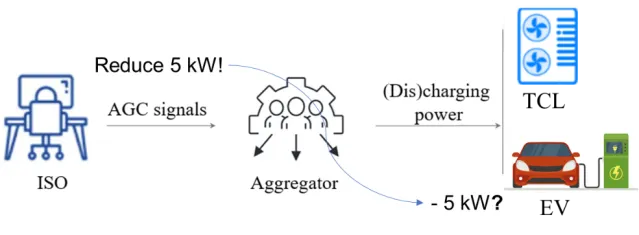
<p>At a certain time period, suppose you’re using electricity normally: the air conditioner is consuming 5kW (rated power 10kW), and the electric vehicle is plugged in but neither charging nor discharging (power range ±5kW). You’ll find that your total upward regulation capacity (reducing consumption) is 5+5=10kW, and your total downward regulation capacity (increasing consumption) is also 5+5=10kW. Obviously, both the air conditioner and the electric vehicle each provide 5kW of regulation capacity. Now, if the grid asks you to adjust upward by 5kW (Figure 1: reduce power consumption by 5kW), how would you control the air conditioner and electric vehicle?</p>

<h2 id="key-challenges">Key Challenges</h2>

<p>The initial strategy of “prioritize turning off the air conditioner” might seem optimal, but several issues need consideration:</p>

<ol>
  <li>
    <p><strong>Uncertainty of grid instructions</strong>: Typical ancillary services like peak regulation, frequency regulation, and reserves have unpredictable grid instructions with multiple possible scenarios.</p>
  </li>
  <li>
    <p><strong>Temporal coupling in VPP operation</strong>: The operation strategy should maximize the VPP’s total profit over the entire time window (e.g., next 24 hours), while state variables like indoor temperature and EV battery energy have temporal coupling characteristics.</p>
  </li>
  <li>
    <p><strong>Second-level control of massive heterogeneous resources</strong>: In reality, a VPP might aggregate tens of thousands of resources with different characteristics, while services like secondary frequency regulation require second-level response.</p>
  </li>
</ol>

<p>The challenge lies in considering both the randomness of grid instructions and the multi-period coupling of VPP benefits to achieve online disaggregation of regulation instructions among massive heterogeneous resources.</p>

<h2 id="solution-method">Solution Method</h2>

<p>Our method uses the shadow prices of resource state variables in the original problem to achieve temporal decoupling. It consists of three steps:</p>

<ol>
  <li>
    <p><strong>Construct optimal VPP operation strategy</strong>: Before each day or hour, solve the original problem with all factors considered to determine the VPP’s optimal hourly bidding and power disaggregation results. Crucially, preserve the shadow prices of all resource state variables.</p>
  </li>
  <li>
    <p><strong>Simplify to optimal disaggregation strategy</strong>: Use the physical meaning of shadow prices to decouple the online control problem temporally, transforming it into a linear program that only considers the current period and current regulation instruction.</p>
  </li>
  <li>
    <p><strong>Fast disaggregation algorithm</strong>: Further leverage the problem structure to develop a fast disaggregation algorithm using only algebraic operations to solve for the optimal disaggregation results.</p>
  </li>
</ol>

<p><img src="/images/post1-4.jpg" alt="Figure 4: Fast disaggregation algorithm" /></p>

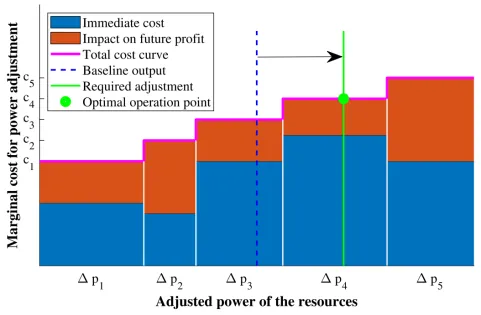
<p>The fast disaggregation algorithm works in two steps: First, based on each resource’s regulation cost and shadow prices of state variables, calculate the marginal adjustment cost for each resource. Then, within the feasible regulation range of resources, adjust from low-cost resources until the required adjustment amount is reached.</p>

<h2 id="numerical-results">Numerical Results</h2>

<p>Using real market prices and RegD signals from PJM in the US, we tested the operating profits of VPPs under different operation strategies:</p>

<ol>
  <li><strong>Proportional Disaggregation</strong> (commonly used in existing literature)</li>
  <li><strong>Greedy Disaggregation</strong> (always using resources with the lowest immediate cost)</li>
  <li><strong>Our Optimal Disaggregation</strong> method (considering grid instruction uncertainty and temporal coupling)</li>
</ol>

<p>Results show that our method significantly improves VPP net profit. Interestingly, the “prioritize turning off the air conditioner” strategy performed worst because it doesn’t consider how current control strategies affect future VPP profits.</p>

<p>We also tested the computation time of different algorithms as the number of distributed resources increases. With over 10,000 resources:</p>

<ol>
  <li><strong>Original optimal operation strategy</strong>: Solving time exceeds several minutes</li>
  <li><strong>Optimal disaggregation strategy</strong>: Solving time at second level</li>
  <li><strong>Fast disaggregation algorithm</strong>: Solving time at millisecond level, involving only algebraic operations</li>
</ol>

<h2 id="method-advantages">Method Advantages</h2>

<p>Our approach for VPPs aggregating massive heterogeneous resources to interact with the grid offers the following advantages:</p>

<ol>
  <li>
    <p>Significantly improves VPP operating profits compared to traditional proportional disaggregation and greedy strategies</p>
  </li>
  <li>
    <p>Uses shadow prices to achieve temporal decoupling, transforming the original large-scale optimization problem into an equivalent small-scale optimization problem</p>
  </li>
  <li>
    <p>Achieves millisecond-level precise control of over 10,000 resources using only basic arithmetic operations</p>
  </li>
</ol>

<h2 id="resources">Resources</h2>

<ul>
  <li>Paper Link: <a href="https://www.sciencedirect.com/science/article/pii/S0306261924002599">APEN-2024</a></li>
  <li>Data and Code: <a href="https://github.com/ruikelyu/Real-time-operation-strategy-of-virtual-power-plants">https://github.com/ruikelyu/Real-time-operation-strategy-of-virtual-power-plants</a></li>
  <li>Video: <a href="https://www.bilibili.com/video/BV1CpQDYDE67">Bilibili Video</a></li>
  <li>Original Chinese Article: <a href="https://mp.weixin.qq.com/s/735kxKLqd2lvPHmqsqO9oA">清华电机系公众号文章</a></li>
</ul>]]></content><author><name>Ruike Lyu</name><email>rl3763@columbia.edu</email></author><category term="Virtual Power Plant" /><category term="Optimal Control" /><category term="Shadow Price" /><category term="Distributed Energy Resources" /><summary type="html"><![CDATA[]]></summary></entry></feed>